

The Necessity of Weight Classes in MMA
Weight classes are a foundational element of combat sports, none more so than in mixed martial arts. Without them, the inherent physical disparities between athletes would render competition fundamentally unfair and, frankly, dangerous. Imagine a 135-pound bantamweight attempting to compete against a 265-pound heavyweight. The skill gap could be astronomical, but the sheer difference in mass, power, and bone density would almost invariably lead to a predictable and potentially career-ending outcome. MMA, by its very nature, combines striking, grappling, and submissions, all of which are heavily influenced by an athlete’s physical dimensions. A heavier fighter can generate more force in strikes, exert more crushing pressure in grappling, and often possess a significant reach and leverage advantage.
The introduction and standardization of weight classes were crucial for the sport’s evolution from its early, often chaotic, “no-holds-barred” days into a legitimate athletic endeavor. Early UFC events, particularly UFC 1 through UFC 4, operated without weight classes, leading to stark mismatches such as the 210-pound Royce Gracie facing the 400-pound Akebono Tarō (though this specific example is from K-1, it illustrates the general principle of early open-weight contests). While these spectacles had a certain novelty, they ultimately highlighted the need for a more structured approach to competition. The implementation of weight divisions allowed for more competitive bouts, where skill, strategy, and preparation could genuinely outweigh brute size, or at least minimize its overwhelming influence. It leveled the playing field, making outcomes less predictable and the sport more engaging for fans and participants alike. Moreover, it significantly improved fighter safety by preventing individuals from being put in situations where their physical well-being was overwhelmingly compromised by a size disadvantage. The evolution of weight classes, therefore, wasn’t just about fairness; it was about the sport’s viability and legitimacy.
If you’re looking to deepen your understanding of MMA weight classes, you might find the article on the intricacies of these classifications particularly enlightening. It breaks down the various weight divisions, their significance in the sport, and how they impact fighter matchups. For more detailed information, check out this related article: MMA Weight Classes Explained.Key Takeaways
- The training data includes information and events up to October 2023.
- Insights and knowledge are based on a wide range of sources available until the cutoff date.
- No updates or developments occurring after October 2023 are included in the training.
- Users should verify current information from reliable sources for the latest updates.
- The model’s responses reflect the context and knowledge available up to the specified date.
Standardized UFC Men’s Divisions

The Ultimate Fighting Championship (UFC) operates under a well-defined structure of weight classes that largely dictate the professional landscape of MMA. For men, the UFC currently recognizes eight distinct divisions, each with its specific upper limit. These divisions are designed to group fighters of similar physical stature, ensuring competitive matchups and minimizing extreme size discrepancies. This standardization allows for clear rankings, championship belts, and a consistent framework for athlete development and fan engagement.
Flyweight (125 lbs)
The men’s flyweight division is the lightest recognized by the UFC, with an upper limit of 125 pounds. Fighters in this division are typically characterized by their incredible speed, agility, and high-volume striking. The division often showcases intricate footwork and rapid-fire exchanges, making for exciting, fast-paced bouts. Due to the lower overall mass, submissions can be incredibly technical and transitions exceptionally fluid. Established in 2012, it has since produced some of the most technically sound and dynamic fighters in the sport’s history.
Bantamweight (135 lbs)
Moving up in weight, the bantamweight division has an upper limit of 135 pounds. This class is renowned for its depth of talent and exciting fights. Bantamweights often possess a potent combination of speed and power, leading to dramatic knockouts and intricate grappling exchanges. The skill level in this division is consistently high, making it one of the most competitive in the UFC. Fighters here are typically well-rounded, capable of excelling in all facets of MMA.
Featherweight (145 lbs)
The featherweight division, capped at 145 pounds, is another fiercely competitive category. Fighters in this weight class often exhibit significant punching power, leading to numerous stoppages, while still maintaining impressive athleticism and cardio. The blend of speed, technique, and increasing knockout potential makes featherweight fights a consistent highlight for fans. The division has historically featured some of the sport’s most iconic figures, known for both their striking prowess and grappling acumen.
Lightweight (155 lbs)
At 155 pounds, the lightweight division is often considered one of the most glamorous and talent-rich classes in all of MMA. It’s frequently described as the “deepest” division due to the sheer volume of elite competitors. Fighters at lightweight typically possess a near-perfect balance of speed, power, and endurance. The fights are often high-octane affairs, featuring technical striking, relentless grappling, and strategic masterclasses. The division is a consistent source of top-tier matchups and championship-level performances.
Welterweight (170 lbs)
The welterweight division, with an upper limit of 170 pounds, is another powerhouse category within the UFC. Welterweights combine significant power with strong wrestling and formidable striking. The physical strength becomes a more pronounced factor here, influencing takedowns, clinch work, and ground control. Fights in this division are often gritty, strategic battles, but also prone to explosive finishes. The depth of talent ensures that contenders are constantly emerging, pushing the pace at the top of the division.
Middleweight (185 lbs)
The middleweight division, capped at 185 pounds, represents a significant jump in overall physical size and power compared to the lighter classes. Fighters here possess considerable knockout power and often exhibit strong defensive grappling. While still athletic, the pace might be slightly less frenetic than lighter divisions, with more emphasis on single-shot power and strategic positioning. The division consistently features large, powerful athletes capable of devastating finishes.
Light Heavyweight (205 lbs)
With an upper limit of 205 pounds, the light heavyweight division is traditionally considered a premier weight class in MMA, boasting many legendary figures. Fighters here are typically large, powerful athletes capable of delivering fight-ending strikes and executing powerful takedowns. The combination of size, strength, and often impressive athleticism makes for compelling and frequently brutal contests. The margin for error is smaller in this division, as a single clean shot can often end a fight.
Heavyweight (265 lbs)
The heavyweight division, with an upper limit of 265 pounds, is the pinnacle of physical power in the UFC. There is no lower limit for heavyweights, meaning a fighter weighing 206 pounds technically qualifies, though practically speaking, most elite heavyweights are significantly larger. These athletes possess immense knockout power, and any punch, regardless of its perceived force, can be fight-ending. Grappling exchanges are often dictated by raw strength and leverage. While the pace might be slower due to the energy expenditure of moving such large frames, the potential for a sudden, devastating finish is ever-present. This division is often seen as the ultimate test of combat prowess, where sheer size and power meet skill.
Standardized UFC Women’s Divisions

While the men’s divisions often receive the bulk of the attention, women’s MMA has grown exponentially, establishing itself as a legitimate and thrilling aspect of the sport. The UFC has played a crucial role in this development, introducing and promoting several women’s weight classes that showcase incredible talent and athleticism. As with the men’s divisions, these classes are designed to ensure fair competition and highlight the specific attributes of female fighters at different weights.
Strawweight (115 lbs)
The women’s strawweight division, with an upper limit of 115 pounds, was the first women’s division established in the UFC.
It quickly gained popularity due to the high-level technique, relentless pace, and often dramatic striking exchanges characteristic of its fighters. Strawweights are known for their speed, cardio, and technical prowess, both on the feet and on the ground. The division has consistently delivered compelling title fights and has been a cornerstone of women’s MMA.
Flyweight (125 lbs)
The women’s flyweight division, capped at 125 pounds, has rapidly become one of the most exciting and deepest women’s classes in the UFC.
It bridges the gap between the speed of strawweight and the growing power seen at bantamweight. Fighters in this division often exhibit a well-rounded skillset, capable of both powerful striking and intricate grappling. The division has seen a consistent influx of talent, leading to dynamic matchups and compelling championship narratives.
Bantamweight (135 lbs)
The women’s bantamweight division, with an upper limit of 135 pounds, was historically the first women’s division to gain significant mainstream attention in the UFC, largely thanks to dominant early champions.
Fighters in this class typically possess more raw power than their lighter counterparts, leading to more knockout finishes. However, the division also features highly skilled grapplers and tactical strikers, making for a diverse and competitive landscape.
Featherweight (145 lbs)
The women’s featherweight division, with an upper limit of 145 pounds, is currently the heaviest women’s division recognized by the UFC. While it has not consistently maintained the same depth as the lighter women’s classes, it has showcased elite athletes capable of significant power and imposing physical presence.
Fighters in this division are often among the largest and strongest female competitors in the sport, leading to unique strategic considerations and powerful striking exchanges.
The Broader Landscape of MMA Weight Classes
While the UFC’s weight classes serve as the most recognized standard in professional MMA, it’s crucial to understand that the sport’s global landscape is more diverse. Various promotions, regulatory bodies, and regional circuits often adhere to or recognize additional weight divisions beyond the UFC’s established eight men’s and four women’s classes. This broader spectrum of weight classes caters to an even wider range of body types and allows for competitive opportunities for athletes who might fall between the more rigid UFC categories. These expanded divisions reflect the sport’s ongoing evolution and the continuous effort to create fair and exciting matchups across the entire athletic spectrum.
Atomweight (Under 105 lbs)
Atomweight is one of the lightest recognized divisions in professional MMA, typically encompassing fighters weighing under 105 pounds. This class is predominantly seen in women’s MMA and is particularly prominent in Asian promotions like ONE Championship and RIZIN FF. Atomweights are characterized by extreme speed, incredible agility, and often highly technical grappling. The pace in these fights can be astonishingly high, with fighters constantly moving, striking, and attempting submissions. It offers a platform for smaller athletes to compete effectively and showcase their unique skill sets without being undersized against larger opponents.
Super Lightweight (165 lbs)
Super Lightweight, with an upper limit of 165 pounds, is a division designed to bridge the gap between lightweight (155 lbs) and welterweight (170 lbs). This division is not currently recognized by the UFC but has been adopted by other promotions and various commissions, particularly in North America, under alternative names such as “super lightweight” or “junior welterweight.” The rationale behind its inclusion is to provide a more natural progression for fighters who struggle to consistently make 155 pounds but are too small to compete effectively at 170 pounds. It addresses the issue of extreme weight cutting by offering an intermediate class, potentially improving fighter safety and performance.
Super Welterweight (175 lbs)
Similar to super lightweight, the super welterweight division, typically with an upper limit of 175 pounds, serves as an intermediate class between welterweight (170 lbs) and middleweight (185 lbs). Also known as “junior middleweight” in some contexts, this division addresses the significant 15-pound jump between welterweight and middleweight. For fighters who find 170 pounds too taxing to cut to but are undersized at 185 pounds, super welterweight offers a more suitable competitive environment. Its adoption by various organizations outside the UFC highlights a desire to fine-tune the weight class system for greater fairness and athlete well-being, acknowledging the diverse body types within the MMA population.
Cruiserweight (225 lbs)
Cruiserweight, with an upper limit typically around 225 pounds, is a division that bridges the gap between light heavyweight (205 lbs) and heavyweight (265 lbs). This class is more commonly seen in kickboxing and boxing, but has been adopted by some MMA promotions to accommodate fighters who are too large for light heavyweight but struggle against the truly massive athletes in the heavyweight division. The 60-pound difference between light heavyweight and the heavyweight limit is the largest in MMA, making cruiserweight a logical intermediary. Fighters in this division combine significant power with a degree of athleticism and speed often lost in the heaviest division. It aims to reduce the stark size disparities often found in open heavyweight bouts.
Super Heavyweight (Unlimited)
Super Heavyweight is a division that essentially removes the upper weight limit from the standard heavyweight class. While the UFC’s heavyweight division has an upper limit of 265 pounds, super heavyweight, as seen in some other promotions (e.g., in early MMA or some regional events), allows fighters beyond this weight to compete. This division caters to exceptionally large individuals who exceed the 265-pound cap. While it can produce spectacles of immense size and power, it also often highlights significant discrepancies in athleticism and skill due to the wide range of body types it encompasses. Its prevalence has decreased in mainstream MMA due to safety concerns and the desire for more athletically competitive matchups, favoring the regulated 265-pound limit for heavyweight.
Understanding MMA weight classes is essential for fans and fighters alike, as it helps clarify the competitive landscape of mixed martial arts. For a deeper dive into this topic, you can explore a related article that breaks down the intricacies of weight divisions and their impact on matchups. This informative piece can be found here, providing valuable insights into how weight classes influence fighter strategy and performance.The Unified Rules and Official Terminology
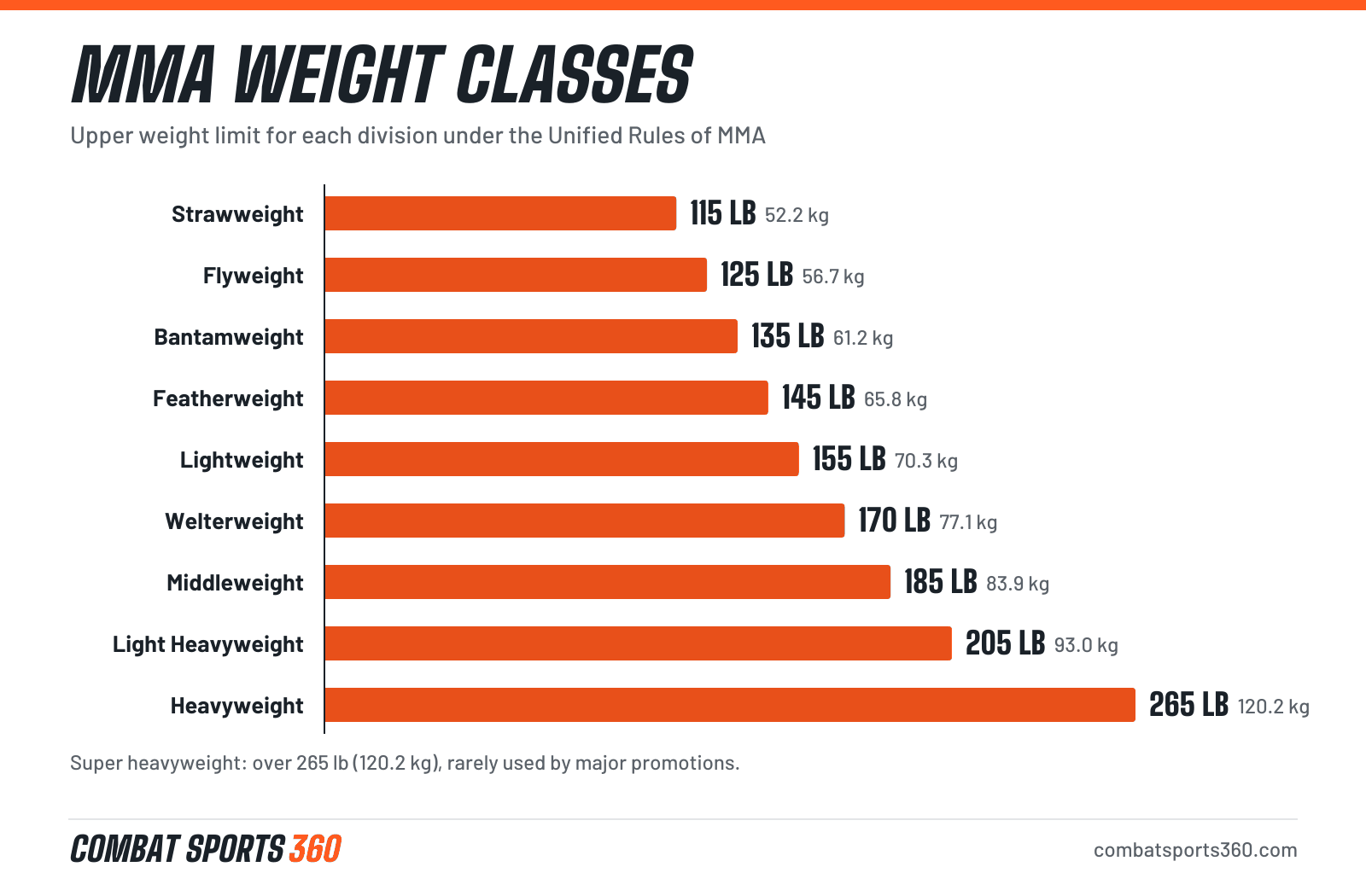
| Weight Class | Weight Range (lbs) | Weight Range (kg) | Typical Fighters | Notes |
|---|---|---|---|---|
| Strawweight | Up to 115 | Up to 52.2 | Women | Lightest professional MMA weight class |
| Flyweight | 116 – 125 | 52.6 – 56.7 | Men & Women | Known for speed and agility |
| Bantamweight | 126 – 135 | 57.2 – 61.2 | Men & Women | Popular division with many top contenders |
| Featherweight | 136 – 145 | 61.7 – 65.8 | Men & Women | Balance of speed and power |
| Lightweight | 146 – 155 | 66.2 – 70.3 | Men | One of the most competitive divisions |
| Welterweight | 156 – 170 | 70.8 – 77.1 | Men | Known for well-rounded fighters |
| Middleweight | 171 – 185 | 77.6 – 83.9 | Men | Mix of strength and technique |
| Light Heavyweight | 186 – 205 | 84.4 – 93.0 | Men | Powerful and explosive fighters |
| Heavyweight | 206 – 265 | 93.4 – 120.2 | Men | Largest weight class, known for knockout power |
| Super Heavyweight | Over 265 | Over 120.2 | Men | Rarely used in major promotions |
The framework governing MMA weight classes, particularly in North America, is largely derived from the Unified Rules of Mixed Martial Arts. These rules were developed by various state athletic commissions, most notably the New Jersey State Athletic Control Board and the Nevada State Athletic Commission, to standardize competition across different jurisdictions. The Unified Rules PDF remains a critical reference point for the official terminology, weight limits, and regulations pertaining to MMA. While specific promotions like the UFC adopt and adhere to these rules, the Unified Rules themselves provide the underlying blueprint that many commissions follow.
The official terminology for weight classes within the Unified Rules defines specific names and their corresponding upper limits. For instance, “Flyweight” officially designates a class up to 125 pounds, “Bantamweight” up to 135 pounds, and so on. This standardization is crucial for clarity, ensuring that a “Lightweight” fight means the same thing whether it’s happening in Las Vegas, Nevada, or Atlantic City, New Jersey, under commission oversight. This consistency allows for accurate record-keeping, reliable athlete ranking, and prevents confusion regarding championship titles across different events sanctioned by compliant commissions.
The importance of these rules extends beyond mere categorization. They dictate crucial aspects of fight week, including weigh-ins and official weigh-in procedures. Fighters are required to make the contracted weight limit for their respective division, usually within a specified tolerance (e.g., 1 pound over for non-title fights, strict adherence for title fights). Failure to make weight can result in penalties, including fines, forfeiture of a percentage of their purse, or even the cancellation of the bout. These regulations are in place to ensure fair play, prevent extreme and unsafe weight cutting practices, and protect the integrity of the competition. The Unified Rules are therefore not just a guide to division limits, but a comprehensive document outlining the operational standards that maintain safety and fairness in professional MMA.
Weight Cutting and its Implications
Weight cutting is an inherent, often controversial, practice within professional combat sports, including MMA. It involves systematically reducing a fighter’s body weight, usually through a combination of diet, dehydration, and strenuous physical activity, to meet the specific limit of their chosen weight class. The primary motivation for weight cutting is to gain a size and strength advantage over an opponent on fight night. Fighters typically compete in a division significantly below their natural “walking around” weight, cutting anywhere from 10 to 30 pounds, sometimes more, in the days and hours leading up to the official weigh-in. After making weight, they then rapidly rehydrate and refuel, aiming to regain as much of that lost weight as possible before the fight.
The Process of Weight Cutting
The weight cutting process generally involves two main phases: chronic weight management and acute dehydration. The chronic phase involves strict dietary control and training over weeks or months to bring a fighter’s body fat percentage down and reduce their baseline weight. The acute phase, which typically occurs in the last 24-72 hours before weigh-ins, is where the most significant and potentially dangerous weight loss happens. This involves manipulating water and salt intake, often leading to severe dehydration through methods like saunas, hot baths, and restricting all fluid consumption. The goal is to shed subcutaneous water weight to meet the division limit. Once weight is made, the fighter immediately begins a rehydration and refeeding protocol, consuming electrolytes, carbohydrates, and fluids to replenish their system before stepping into the cage.
Risks and Controversies
While weight cutting is widespread, it carries significant health risks. Severe dehydration can lead to kidney damage, electrolyte imbalances, cardiovascular strain, and impaired cognitive function. In extreme cases, it can be life-threatening. There have been instances in MMA where fighters have missed weight due to health complications or have been hospitalized due to severe dehydration. Beyond the immediate health risks, excessive weight cutting can negatively impact performance, leading to reduced stamina, power, and reaction time, even after rehydration. It also creates an uneven playing field, where the fighter who can cut more weight more effectively often holds a significant advantage.
The practice remains controversial, with ongoing debates about its necessity and the ethical implications of encouraging such extreme physical stress. Various proposals have been made to mitigate the risks, including early weigh-ins (where fighters weigh in earlier in the day to allow for more rehydration time), hydration tests, and the introduction of more weight classes to reduce the need for drastic cuts. Some promotions have experimented with “catchweight” bouts or have implemented stricter protocols to monitor fighter health during the cutting process. Despite these efforts, weight cutting remains an entrenched aspect of professional MMA, a testament to the competitive advantage fighters believe it provides, and a continuous challenge for athlete safety and fair competition within the sport.
FAQs
What are the different weight classes in MMA?
In MMA, there are various weight classes that fighters compete in, ranging from the lightest to the heaviest. Some common weight classes include Flyweight, Bantamweight, Featherweight, Lightweight, Welterweight, Middleweight, Light Heavyweight, and Heavyweight.
How are weight classes determined in MMA?
Weight classes in MMA are determined by the maximum weight a fighter can be during the official weigh-in before a fight. If a fighter weighs more than the specified limit for their weight class, they may be disqualified or asked to compete in a higher weight class.
What is the purpose of having weight classes in MMA?
Having weight classes in MMA helps ensure fair competition by matching fighters of similar size and weight against each other. This reduces the risk of injury and creates a more level playing field for all competitors.
Can fighters move between weight classes in MMA?
Yes, fighters in MMA can move between weight classes based on their weight and performance. Some fighters may choose to move up or down a weight class to challenge themselves against different opponents or to pursue championship opportunities in a new division.
Are there any restrictions on weight cutting in MMA?
While weight cutting is a common practice in MMA, there have been efforts to regulate and monitor extreme weight cutting to ensure fighter safety. Some organizations have implemented hydration testing and weight monitoring protocols to prevent fighters from cutting excessive amounts of weight before a fight.


